
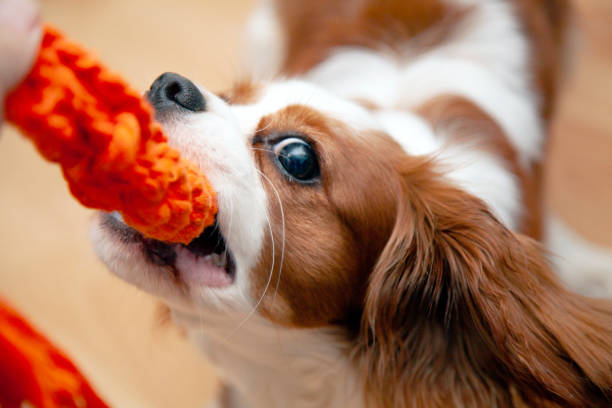
A Cavalier King Charles Spaniel puppy holding an orange coloured toy in her mouth and looking up
It sounds like you have a dog who enjoys the thrill of “keep away”! This game, while sometimes frustrating for owners, is actually a great sign of a dog’s intelligence, problem-solving skills, and desire to interact. It’s important to channel this energy into fun and constructive activities.
This guide will cover:
- Understanding Why Dogs Play Keep Away
- Essential Preparation for Keep Away Play
- Fun and Engaging Keep Away Activities
- Advanced Keep Away Games
- Troubleshooting and Managing Keep Away
- When to Seek Professional Help
Let’s dive in!
Understanding Why Dogs Play Keep Away
Before we get into the “how,” let’s understand the “why.” Dogs play keep away for several reasons:
- Resource Guarding (Mild Form): While not always aggressive, it can be a mild manifestation of wanting to control a prized possession. They’ve “got it,” and they don’t want you to take it back easily.
- The Chase Instinct: Many dogs have a strong prey drive. The act of being chased is inherently rewarding, triggering their predatory sequence (stalk, chase, capture).
- Learned Behavior: If they’ve been successful (you’ve chased them and they’ve had fun or kept the item), they’ll repeat the behavior.
- Testing Boundaries and Leadership: Some dogs use this as a way to test their owner’s reaction and assert a (perceived) form of dominance.
- Attention Seeking: They might realize that when they grab something and run, they get your undivided attention, even if it’s negative attention.
- It’s Just Fun! For many dogs, the excitement and interaction of the game are simply enjoyable.
Essential Preparation for Keep Away Play
To make keep away a positive experience for both you and your dog, proper preparation is key.
1. Choose the Right “Toys”
Not all items are suitable for keep away.
- Appropriate Toys: Focus on toys designed for fetch and tug-of-war. These should be items you initiate the game with and can easily get back. Examples include:
- Soft plush toys (avoid those easily destroyed and ingested)
- Durable rubber balls
- Rope toys
- Frisbees
- Inappropriate Items: Never let your dog play keep away with items that are:
- Valuable to you (shoes, remote controls, important documents)
- Dangerous if chewed or ingested (small objects, electrical cords, toxic substances)
- Items that will cause you extreme frustration if lost or damaged (e.g., a beloved garden gnome).
2. Teach a Solid “Drop It” or “Give” Command
This is crucial for managing keep away. Your dog needs to understand that when you ask for the item, they should release it.
- How to Train “Drop It”:
- Start with a low-value toy your dog enjoys.
- Encourage your dog to pick it up.
- Hold a high-value treat near their nose.
- As they release the toy to investigate the treat, say “Drop it!” and give them the treat.
- Once they reliably drop for a treat, start practicing without the immediate treat, rewarding them with praise and a different toy or a short interaction.
- Gradually increase the difficulty by asking them to “drop it” when they have more exciting toys or when you’re in more distracting environments.
- Always trade for something better! Never just take the toy away without a reward.
3. Practice Recall (The “Come” Command)
A strong recall is essential, especially if your dog tends to run off with items.
- How to Train Recall:
- Start in a quiet, enclosed area.
- Call your dog’s name followed by “Come!” in a happy, inviting tone.
- When they come to you, reward them enthusiastically with treats, praise, and a brief play session.
- Gradually increase distractions and distance.
- Never call your dog to you for something unpleasant (like a bath or nail trim) if you want a reliable recall.
4. Build a Strong Bond and Trust
Your dog is more likely to engage playfully and release an item if they trust you and enjoy interacting with you. Spend quality time playing other games, training, and exercising together.
Fun and Engaging Keep Away Activities
The goal is to turn the keep away instinct into structured play that benefits both of you.
1. The Controlled Keep Away Chase
This is the most straightforward approach.
- How to Play:
- Initiate: You start with a toy.
- Offer: Present the toy to your dog.
- Entice: As they take it, feign a bit of playful interest and then gently start to walk away or back up.
- Encourage the Chase: Wiggle the toy, make excited noises, and let your dog “win” by taking it from you.
- The “Drop”: After a few seconds, entice them to drop it with a treat or by offering a different toy.
- Repeat: As soon as they drop it, immediately praise them and offer the toy back to them or a different one to start the game again.
- Key: You are controlling the game. You decide when it starts, when it ends, and the dog always gets the toy back or a reward for releasing it. This prevents true resource guarding.
2. The “Trade Up” Game
This is a variation of controlled keep away that teaches your dog that giving up an item leads to something even better.
- How to Play:
- Give your dog a toy they enjoy.
- When they have it, present a much higher value reward (a super-tasty treat, a special squeaky toy they don’t get often).
- As they release the first toy to get the better reward, say “Drop it!”
- Give them the high-value reward.
- After they’ve enjoyed the treat, you can go back to playing with the original toy.
- Goal: To teach them that “giving” their item results in an even better outcome.
3. Tug-of-War (with Rules!)
Tug-of-war shares many elements with keep away, particularly the chase and possession aspects.
- How to Play:
- Initiate: You start the tug game.
- Clear Rules: Your dog should only tug when commanded. They should release the toy when you say “Drop it!”
- Controlled Play: If your dog starts growling excessively, their teeth touch your skin, or they become too intense, the game stops immediately. You can say “Game over” and put the toy away for a few minutes. This teaches them to control their excitement.
- You Initiate and End: You present the toy to begin the tug and you decide when it stops.
4. Fetch with a Twist
While fetch is about returning the item, you can incorporate elements of keep away to make it more engaging for your dog.
- How to Play:
- The Teaser: When you throw the ball, don’t throw it too far initially. Let your dog catch up to it.
- The Gentle Chase: As they grab it, start walking towards them, making playful noises. You might even pretend to “try” to get it from them.
- The “Drop”: Encourage them to drop it by offering a treat or another ball.
- The Relay: If you have multiple balls, as soon as they drop one, throw another. This keeps the momentum going and rewards them for dropping.
- The “Almost Got It”: If they’re running away with the ball, don’t chase them immediately. Instead, try to entice them to come back to you with a happy voice or by showing them a treat.
Advanced Keep Away Games
Once your dog has a solid understanding of “drop it” and recall, you can try more challenging games.
1. Hide and Seek with the Toy
This turns the keep away instinct into a problem-solving puzzle.
- How to Play:
- Have your dog in another room or crated.
- Take a favorite toy and hide it somewhere visible but slightly challenging (behind a cushion, under a blanket, on a low shelf).
- Bring your dog back into the room and encourage them to find the toy.
- When they find it, celebrate! You can even initiate a short game of keep away with it.
- Advanced: Gradually increase the difficulty of the hiding spots. You can also start telling your dog “Go find it!” to cue them.
2. The Obstacle Course Keep Away
Combine keep away with agility or fun obstacles.
- How to Play:
- Set up a simple obstacle course (e.g., a tunnel, low jump, weave poles).
- Start with the toy at the end of the course.
- Have your dog complete the course to reach the toy.
- As they get closer, you can playfully engage them, making them “work” for it.
- The Challenge: Once they have the toy at the end, you can initiate a short game of controlled keep away, encouraging them to drop it so you can re-hide it or send them through the course again.
3. “Steal the Bacon” (Doggy Version)
This is a classic game that can be adapted for dogs.
- How to Play:
- You’ll need two identical toys and two people (or one person and a helper).
- Place the two toys at opposite ends of a room or yard.
- Have your dog in the middle, with the people on either side, each holding one toy.
- When you say “Go!”, the dog runs to grab one toy.
- The goal is for the dog to “steal” the toy from the other person.
- Crucial: Both participants must be willing to let the dog take the toy. The “loser” can then try to playfully retrieve the toy from the dog, initiating a short, controlled keep away. The emphasis is on fun and engagement, not a true conflict.
Troubleshooting and Managing Keep Away
Keep away can sometimes escalate or become problematic. Here’s how to manage it.
1. Prevent the “No Take, Only Throw” Scenario
This is when your dog only wants to play if you throw the toy, but will not give it back.
- Solution: Always end fetch by asking for a “drop it” or a trade. Never just grab the toy. Make returning the toy rewarding.
2. Don’t Chase Your Dog (Generally)
Chasing your dog when they have something they shouldn’t usually reinforces the keep away behavior.
- What to Do Instead:
- Become Uninteresting: Turn your back, walk away, or pretend to ignore them. Often, the dog will come to you to re-engage.
- Use a “Trade”: Show them a high-value treat or a more exciting toy.
- Redirect with Voice: Use a cheerful “Come here!” or “What’s this?” to entice them back to you.
3. Manage the Environment
If your dog is prone to grabbing things they shouldn’t, manage their environment.
- Put away valuables: Don’t leave shoes, remotes, or other tempting items accessible.
- Use crates or baby gates: When you can’t supervise them closely.
- Provide plenty of appropriate toys: Ensure they have enough stimulating toys to keep them occupied.
4. Recognize and Avoid Resource Guarding
While a playful keep away is fun, true resource guarding can be a more serious issue. If your dog:
- Growls, snarls, or shows teeth when you try to take the item.
- Becomes stiff and tense.
- Swipes or snaps.
- Eats the item quickly to swallow it.
This is NOT the playful keep away we’re discussing. This requires professional intervention. The games above are designed to be positive and build trust, not to encourage guarding.
When to Seek Professional Help
If you suspect your dog’s keep away behavior is escalating into true resource guarding, or if you’re struggling to manage the behavior despite consistent training, it’s time to consult a professional.
- Certified Professional Dog Trainer (CPDT-KA or CPDT-KSA): Can assess the behavior and provide structured training plans.
- Veterinary Behaviorist (DACVB): For more severe cases of aggression or anxiety related to resource guarding.
Conclusion
Dogs who love to play keep away are often intelligent, energetic, and eager to interact. By understanding the underlying motivations and channeling that energy into structured, fun games like controlled chases, trade-ups, and modified fetch, you can strengthen your bond with your dog, improve their obedience, and ensure that this playful instinct remains a source of joy, not frustration. Remember to always prioritize safety, have the right tools (like a solid “drop it” command), and make it a positive experience for everyone involved! Happy playing!






Add comment