
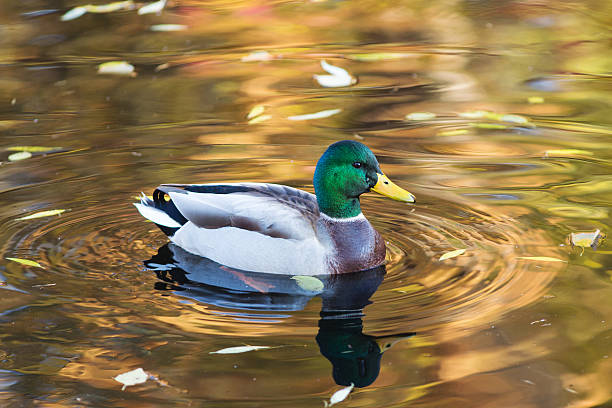
Why Conformation Matters
Conformation is the physical embodiment of a breed’s standard. In the world of waterfowl exhibition, a duck’s shape, proportion, carriage, and plumage are not merely aesthetic; they are the tangible expression of centuries of selective breeding, genetic intent, and functional adaptation.
- Judicial Consistency: Judges rely on a written standard to award points impartially. A clear, universally understood conformation criterion eliminates subjectivity.
- Genetic Health: Deviations often signal hidden health or genetic problems (e.g., skeletal malformations, metabolic disorders).
- Market Value: Show‑winning birds command premium prices, and a flawless conformation directly translates to higher market demand.
Understanding conformation—down to the millimetre—is therefore essential for every exhibitor who aspires to be more than a hobbyist and wishes to compete at the highest levels (AAU, NABBA, USDA‑certified shows, etc.).
2. The Anatomy of a Show‑Quality Duck – A Systematic Overview
Below is a concise anatomical map of the duck, annotated with the aspects that judges scrutinise.
| Region | Key Attribute | Ideal Presentation | Typical Faults |
|---|---|---|---|
| Head | • Size & shape (rounded, not overly long) • Bill (broad, even, correctly coloured) • Eyes (bright, clear) |
Proportionate to body; bill should sit centrally with a smooth transition to the neck. | Over‑long skull, “sick‑beak” (crooked), dull eye colour, uneven feathering. |
| Neck | • Length (breed‑specific) • Carriage (graceful, not stiff) • Feathering (tight, glossy) |
Smooth curve from head to body; no visible “kinks.” | Hyper‑extended neck, feather loss, excessive bobbing. |
| Body (Torso) | • Depth (well‑rounded, not flattened) • Length (proportionate) • Breast (broad, muscular) |
Full, compact silhouette; a “turtle‑shell” shape for many breeds. | Bow‑legged stance, shallow chest, flabby abdomen. |
| Wings | • Position (held close to body, not drooping) • Feather structure (tight, no gaps) |
Wings should lie flat against the back, forming a smooth line to the tail. | Wing‑droop, feather breakage, uneven margins. |
| Legs & Feet | • Length (short for most breeds, longer for Runners) • Alignment (straight, not splayed) • Foot webbing (tight, evenly coloured) |
Strong, well‑set legs that support a balanced stance. | “Splay‑leg,” “knuckling,” scaly or dirty webbing. |
| Tail | • Shape (rounded, not pointed) • Feather coverage (dense) |
Tail should blend seamlessly with the back, providing a solid base. | “Tail‑drop,” missing feathers, ragged edges. |
| Plumage | • Colour (breed‑specific) • Pattern (sharp, no blurring) • Gloss (high luster, no dullness) |
Even, bright, and clean; no stray bars or “ghost” markings. | Faded colour, feather breakage, “molt‑fuzz.” |
| Overall Carriage | • Balance (center of gravity over feet) • Movement (fluid, purposeful) |
Duck should appear confident, upright, and steady while walking. | “Waddle‑over,” excessive bobbing, hunched posture. |
3. General Principles Applied Across All Breeds
While each breed has its own quirks, five universal tenets underlie every conformation standard:
- Proportion – Every part must be in scale with the whole. A duck that is “big‑headed” or “long‑bodied” is automatically penalised.
- Symmetry – Left‑right mirroring is a hallmark of sound genetics. Asymmetry often indicates developmental anomalies or injuries.
- Structural Soundness – Bones must be straight, joints articulated correctly, and the skeletal framework robust enough to support the plumage without sagging.
- Plumage Integrity – Feather quality is as important as colour. Uniform texture, proper molt timing, and lack of broken quills are strictly judged.
- Breed‑Specific Signature Traits – These are the “signature moves” a judge will look for: the deep, rich chocolate of a Cayuga, the glossy lavender of a Swedish Blue, the pronounced “moustache” of a Call Duck, etc.
Every exhibitor should internalise these principles before tackling breed‑specific nuances.
4. Breed‑Specific Standards
Below each breed is summarised with the most frequently cited points from the American Poultry Association (APA) Standard of Perfection, the British Waterfowl Association (BWA) guidelines, and the International Waterfowl Federation (IWF).
NOTE: Measurements are given in both inches (in) and centimetres (cm) to aid global participants.
4.1 Pekin (American Standard)
- Size: Large; drakes 28–30 in (71–76 cm), hens 26–28 in (66–71 cm).
- Head: Broad, rounded, with a short, deep bill that is bright orange‑yellow.
- Neck: Medium‑length, held in a graceful arch, smooth feathering.
- Body: Deep, broad, and well‑rounded; breast should be muscular and conspicuous.
- Wings: Close to the body, with a clean, even margin; no wing‑droop.
- Legs: Short, set far back, thick, bright orange‑yellow (no black); toes well‑set.
- Plumage: Pure, brilliant white with a high sheen; no greying or “frosting.”
- Faults: Black pigment in legs, feather gaps, “puffy” breast, over‑long neck.
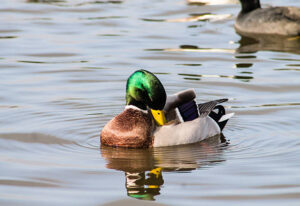
4.2 Mallard (Standard Waterfowl)
- Size: Medium; drakes 20–22 in (51–56 cm), hens 19–21 in (48–53 cm).
- Head: Distinct “crown” of iridescent green (drake) or brown (hen); bill black with a pale tip.
- Neck: Long, slender, elegant; should present a smooth curve.
- Body: Streamlined; chest narrow yet well‑defined.
- Wings: Long, held close; primary feathers must be crisp.
- Tail: Long and pointed; feathering dense.
- Plumage: Classic “male” pattern—green head, white neck ring, chestnut breast, black tail with white bars; hens more muted brown.
- Faults: Dull iridescence, feather loss at the neck ring, short wings, malformed tail.
4.3 Runner (American & British)
- Size: Large; drake 28–30 in (71–76 cm), hen 26–28 in (66–71 cm).
- Head: Small, wedge‑shaped, with a short, fine bill; colour varies (white, black, blue).
- Neck: Very long and upright; should be straight, not “crowned.”
- Body: Slender, elongated, with a shallow keel; the hallmark “runner’s silhouette.”
- Legs: Long and thin, set relatively far back; should be straight, not splayed.
- Plumage: Solid colour with minimal pattern; examples include White Runner, Blue Runner, Chocolate Runner.
- Faults: Pigeon‑chest (over‑rounded body), short neck, heavy bone structure, leg splay.
4.4 Call Duck (American)
- Size: Small; drake 15–16 in (38–41 cm), hen 14–15 in (36–38 cm).
- Head: Broad, rounded; bill short, bright orange‑yellow.
- Neck: Short, upright, giving a “cobby” appearance.
- Body: Compact, broad; chest should be deep but not over‑bulked.
- Tail: Short, rounded, sits low.
- Plumage: Wide colour range (white, black, chocolate, blue, etc.) – each colour must be solid and uniform.
- Faults: Over‑long neck, ragged feather edges, weak bill colour, leg splay.
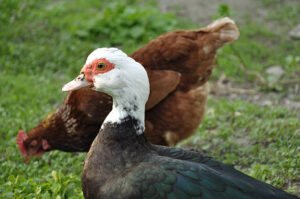
4.5 Muscovy (American & International)
- Size: Very large; drake 28–30 in (71–76 cm), hen 26–28 in (66–71 cm).
- Head: Broad, with a pronounced “caruncle” (red fleshy growth) that should be well‑developed and symmetrical.
- Bill: Thick, deep, bright orange‑yellow; no black pigment.
- Neck: Short, stout, set low.
- Body: Deep, heavy, round; breast muscular.
- Legs: Short, thick, bright orange‑yellow; toes should be clean.
- Plumage: Generally black with a glossy sheen; some varieties have white, silver, or bronze “mosaic” patterns.
- Faults: Undeveloped caruncle, weak leg colour, feather gaps, excessive “fluff” on the head.
4.6 Aylesbury (British)
- Size: Large; drake 29–31 in (74–79 cm), hen 27–29 in (69–74 cm).
- Head: Large, rounded, with a deep, clear orange‑yellow bill.
- Neck: Medium‑length, held high, smooth feathering.
- Body: Deep, broad, with an exaggerated, well‑rounded breast—often described as “pot‑bellied.”
- Legs: Short, thick, bright orange‑yellow; well‑set.
- Plumage: Pure white, shining, dense, with no yellow tint.
- Faults: Yellow undertone, weak breast definition, leg colour dilution, feather breakage.
4.7 Cayuga (American)
- Size: Medium; drake 24–26 in (61–66 cm), hen 22–24 in (56–61 cm).
- Head: Rounded, with a short, dark (black) bill that may have a thin orange tip.
- Neck: Medium, smooth, slightly arched.
- Body: Deep, well‑rounded, with a compact breast.
- Plumage: Uniform, glossy chocolate‑brown (sometimes called “cayuga” colour), no flecks or shading.
- Faults: Fading colour, any white or grey feathering, “bronzing” of the plumage.
4.8 Swedish Blue (International)
- Size: Medium; drake 22–24 in (56–61 cm), hen 20–22 in (51–56 cm).
- Head: Lightly rounded, with a blue‑grey bill that has a thin orange tip.
- Neck: Medium‑length, elegant curve.
- Body: Compact, deep‑breasted.
- Plumage: Uniform blue‑grey with a subtle iridescent sheen; no black or white markings.
- Faults: Colour dilution, any black spotting, poor sheen, feather gaps.
4.9 Other Notable Breeds
| Breed | Key Conformation Highlights | Typical Show Points |
|---|---|---|
| Indian Runner (Standard) | Extreme neck length, upright carriage, sleek silhouette. | “Runner’s posture” – hold head high, keep legs straight. |
| Silver Appleyard | Heavy, deep‑breasted, rich black‑silver patterned plumage. | Uniform pattern, clean “silver” shoulders. |
| Rouen | Large, heavy, elegant Mallard‑type with deeper breast and longer wings. | “French Mallard” – longer, rounded body, rich chestnut. |
| Barbary | Small, ornamental, bright colour, short neck, stout body. | Compact “ball‑like” shape, vivid plumage. |
| Khaki Campbell | Medium, utility‑type, solid khaki colour, high egg‑production trait (though not a judging factor). | Smooth, even colour, tidy feathering. |
Tip: When you first approach a new breed, acquire a breed standard checklist (often supplied by the APA/BWA) and tick each attribute as you evaluate individual birds. This systematic approach reduces oversight and builds confidence.
5. Measuring & Scoring: The Judge’s Toolkit
5.1 Tools of the Trade
| Tool | Purpose | Recommended Specs |
|---|---|---|
| Rigid Measuring Tape | Body length, wing span, leg length | 0.1 in (0.5 mm) increments, non‑stretchable |
| Calipers | Bill width, tarsus (leg) circumference | Vernier or digital, ±0.01 in accuracy |
| Scale (Digital) | Live weight (optional for some classes) | 0.01 lb (0.5 g) precision |
| Plumage Magnifier | Close inspection of feather quality | 5×‑10×, LED illumination |
| Marking Grid (Paper) | Photographic documentation of conformation angles | A4 size, 1‑cm grid lines |
5.2 Standard Measurement Points
| Feature | Measurement Technique | Ideal Range (Breed‑Specific) |
|---|---|---|
| Overall Length | From tip of bill to the base of tail (excluding the tail feathers) | Pekin: 28‑30 in (71‑76 cm) |
| Wing Span | From tip of one wing to tip of opposite wing (wings fully extended) | Runner: 30‑32 in (76‑81 cm) |
| Bill Length | From base (where it meets the skull) to tip | Call: 1.25‑1.5 in (3.2‑3.8 cm) |
| Tarsus Length | From the joint to the tip of the foot | Muscovy: 1.75‑2.0 in (4.5‑5.1 cm) |
| Weight (optional) | Live weight on a scale, with bird calm and without droppings | Khaki Campbell: 4‑5 lb (1.8‑2.3 kg) |
5.3 Scoring Methodology
Most exhibitions use the “point system” where the breed standard is broken into 10‑15 major categories, each worth a set number of points (e.g., 5‑15). The judge awards a percentage of the points based on the bird’s adherence.
- Head & Bill (10 pts) – Colour, shape, proportion.
- Neck (5 pts) – Length, carriage, feathering.
- Body (15 pts) – Depth, breast, overall silhouette.
- Wings (10 pts) – Position, feather quality.
- Legs & Feet (10 pts) – Length, alignment, colour.
- Tail (5 pts) – Shape, feather density.
- Plumage Colour & Pattern (15 pts) – Consistency, brilliance.
- Overall Carriage & Movement (10 pts) – Balance, gait.
- Condition & Health (5 pts) – Skin cleanliness, absence of disease.
- Special Breed‑Specific Traits (10‑15 pts) – Caruncle in Muscovy, “crown” in Mallard, etc.
Total: 100 points. A bird scoring ≥ 90 is typically a first‑place contender; 80‑89 can earn reserve or place depending on competition depth.
6. Common Faults and How to Correct Them
| Fault | Why It Happens | Corrective Action |
|---|---|---|
| Splayed Legs | Genetic predisposition, poor nutrition, improper perching. | Introduce leg‑support bands during early growth, ensure a balanced diet rich in vitamin D & calcium, cull severely affected lines. |
| Crooked Bill | Over‑growth of keratin, lack of proper “bill‑hardening” feed. | Provide soft grit and calcium‑rich grit, regular “bill‑massage” by gently rubbing the bill to encourage even wear. |
| Molt‑Fuzz (Patchy Plumage) | Inadequate nutrition, stress, parasites. | Introduce high‑protein pelleted feed (18‑20 % protein) during molt, treat for mite/lice, minimise handling stress. |
| Weak Breast Musculature | Over‑feeding leading to fat deposits, insufficient exercise. | Encourage water‑foraging (shallow pond) or flight‑practice in a safe aviary, restrict grain to avoid obesity. |
| Dull Colour | Poor feather condition, exposure to sunlight (UV bleaching). | Provide shade, supplement diet with carotenoids (marigold petals, corn) for brighter yellows/red, use feather‑conditioners (horticultural oil spray) sparingly. |
| Excessive “Puffy” Neck | Genetic trait (often seen in Call Ducks). | Select breeding stock with tighter necks, use neck‑brace in juveniles for proper posture. |
| Undeveloped Caruncle (Muscovy) | Age (caruncle develops after 6 months), poor health. | Ensure optimal health, supplement with vitamin A and beta‑carotene; avoid breeding Muscovies before full maturity. |
| Over‑long Tail | Incorrect line breeding (e.g., Mallard × Runner hybrids). | Trim tail feathers post‑molt under veterinary supervision; avoid cross‑breeding unless aiming for a specific hybrid. |
| Weight Imbalance | Over‑feeding, lack of exercise, genetic predisposition. | Adopt a controlled feeding schedule; weigh birds weekly and adjust rations accordingly. |
Proactive Management: The best prevention is a breeding program that records pedigree, conformation scores, and health data. Over generations, deleterious traits can be phased out while desirable ones are reinforced.
7. Pre‑Show Preparation: Grooming, Handling, and Presentation
- Three‑Day Conditioning
- Day – 3: Reduce grain intake to 70 % of normal; increase high‑protein feed (e.g., boiled eggs, soy).
- Day – 2: Introduce light misting (fine water spray) to enhance feather sheen.
- Day – 1: Give a warm‑water bath (no soap), gently towel‑dry, and apply a light feather‑condition spray (optional for breeds with glossy standards, like Pekin).
- Plucking & Tail‑Feather Management
- Many judges prefer a clean tail with the “feather‑cover” removed; however, verify the show rulebook. If allowed, use a fine‑tooth comb to pull loose feathers gently.
- Nail Trimming
- Trim the hallux (inner toe) and outer toe to a length just above the foot pad to avoid scratching the display table.
- Transport Crate
- Use a ventilated, non‑slippery crate (PVC or heavy‑duty plastic). Line the bottom with cotton bedding; avoid newspaper (static).
- Insert a small water dish (no more than 30 ml) to keep the duck hydrated without spillage.
- On‑Stage Handling
- Approach the bird calmly, placing a hand under the keel to support the breast, then lift with the other hand supporting the rear.
- Keep the bird still for 10‑15 seconds while the judge inspects – this demonstrates the bird’s calm temperament, a desirable trait.
- Post‑Show Care
- Return birds to a quiet, temperature‑controlled area; offer electrolyte‑enhanced water (commercial poultry rehydration solution).
- Observe for stress‑related signs (fluffed plumage, reduced feed intake) and adjust diet accordingly.
8. Health, Nutrition, and Welfare Considerations
While conformation is primarily a visual metric, underlying health drives the ability to achieve those standards.
| Area | Key Components | Practical Recommendations |
|---|---|---|
| Diet | Protein (18‑20 % for adults, 22‑24 % for growing ducklings) Vitamins (A, D, E) Minerals (Ca, P, Zn) |
Use a commercial waterfowl feed as a base; supplement with greens (lettuce, kale) and insects (mealworms) for enrichment. |
| Water Quality | Clean, chlorination‑free water; temperature 65‑75 °F (18‑24 °C) | Change water twice daily; provide a shallow pool for natural foraging. |
| Parasite Control | External (mites, lice) Internal (coccidia, worms) |
Monthly dust baths with diatomaceous earth; rotate anticoccidial meds per vet guidance. |
| Vaccination | Newcastle disease, Avian influenza, Pasteurella (as per region) | Follow the local veterinary schedule; keep vaccination records accessible for shows. |
| Housing | Adequate space (≥ 5 sq ft per bird), ventilation, predator‑proofing | Use wire‑mesh raised flooring to prevent foot‑rot; provide perches for leg health. |
| Stress Management | Minimise loud noises, sudden movements, overcrowding | Implement quiet “downtime” periods (2–3 hrs) before the show. |
Welfare Tip: A bird that is well‑fed, rested, and stress‑free will display brighter plumage, tighter feather alignment, and a confident gait—each of which adds points to the judge’s evaluation.
9. Breeding for Conformation: Genetics and Selection Strategies
9.1 Understanding Inheritance
- Polygenic Traits: Most conformation attributes (size, depth, plumage sheen) involve multiple genes. Selection pressure on one trait can inadvertently affect another.
- Mendelian Traits: Colour patterns (e.g., black vs. blue) often follow simple dominant/recessive inheritance.
Tools:
- Punnett Squares for quick visualisation of colour inheritance.
- Quantitative Trait Loci (QTL) Mapping (advanced breeders) to identify markers linked to body depth or leg alignment.
9.2 Establishing a Breeding Plan
- Set Clear Objectives – e.g., “Increase breast depth by 0.2 in while maintaining white plumage purity.”
- Select Foundation Stock – Choose birds scoring ≥ 85 pts in the target attributes.
- Maintain a Pedigree Database – Use software (e.g., Breeder’s Edge, Pedigree Viewer) to track lineage, scores, and health records.
- Implement a “Line‑Breeding” Strategy – Mate close relatives (half‑siblings) to fix desired traits, but avoid inbreeding coefficients > 6 % to prevent recessive faults.
- Cross‑Breeding for Hybrid Vigor – Occasionally introduce unrelated high‑quality stock to combat genetic drift.
9.3 Evaluating Offspring
- First‑Year Scoring: Record scores at 6 months (pre‑molt) and 12 months (post‑molt).
- Statistical Analysis: Use ANOVA to determine if differences between litters are significant.
- Cull or Retain: Birds consistently scoring below 70 pts in key categories should be culled from the breeding program.
9.4 Genetic Health Screening
- DNA Testing: For known recessive diseases (e.g., Duckling Viral Enteritis susceptibility, Muscovy Caruncle hypoplasia).
- Blood Work: CBC and plasma biochemistry to pre‑emptively catch metabolic disorders.
10. Record‑Keeping, Documentation, and Showing History
A comprehensive logbook is indispensable. The following sections should be included for each bird:
| Section | Content |
|---|---|
| Identification | Band number, hatch date, parent IDs, colour, sex. |
| Health Log | Vaccinations, treatments, parasite checks, weight trends. |
| Conformation Scores | Date, judge, venue, scores per category, overall ranking. |
| Photographic Record | Front, side, rear, close‑ups of head, neck, tail. |
| Breeding Decisions | Mates selected, reasoning, outcomes (egg count, hatchability). |
| Show‑Specific Notes | Transportation method, pre‑show conditioning, any faults noted. |
Digital Tools:
- Google Sheets with conditional formatting for quick visual alerts (e.g., weight > target).
- Cloud‑based photo storage (Google Photos, Dropbox) with metadata tags for breed, year, and show.
Organised records simplify trend analysis and help you present a stud book if you ever aim for elite breeder status within AJCA (American Junior Club of Aviculture) or similar bodies.
11. Resources, Clubs, and Further Reading
| Resource | Type | How It Helps |
|---|---|---|
| American Poultry Association (APA) – Standard of Perfection | Reference Book | Official breed standards, measurement guidelines. |
| British Waterfowl Association (BWA) Handbook | Handbook | UK‑specific show rules, historical breed information. |
| International Waterfowl Federation (IWF) Technical Papers | Academic Papers | Genetics, nutrition, and disease control research. |
| “The Waterfowl Keeper” (Quarterly Magazine) | Magazine | Latest trends, breeder interviews, case studies. |
| The Poultry Club of Great Britain – Conformation Workshops | Workshops | Hands‑on training, judge‑led demonstrations. |
| University of Georgia – Extension Service – Duck Nutrition Bulletin | Extension Publication | Proven feeding regimes, molt management. |
| Online Forums – DuckNet, WaterfowlTalk | Community | Peer support, troubleshooting, networking. |
| YouTube Channel “ShowDuck Academy” | Video Series | Visual tutorials on handling, grooming, and judging. |
Tip: Join at least one local waterfowl club. Participation in club shows early in a duck’s life builds confidence and gives you early feedback on conformation before entering national-level competition.
12. Conclusion – The Path to Consistent Success
Achieving top‑tier conformation in exhibition ducks is a multifaceted endeavour. It requires:
- Deep knowledge of breed standards – Master the fine details that differentiate a “good” bird from a “great” one.
- Rigorous health and welfare practices – A healthy duck naturally expresses the breed’s ideal shape and colour.
- Meticulous preparation – From grooming to transportation, every step influences the judge’s perception.
- Strategic breeding – Use genetics wisely, maintain solid records, and eliminate faults early.
- Continuous learning – Stay current with research, attend workshops, and seek mentorship from seasoned exhibitors.
When these pillars are in harmony, your ducks will not only shine in the show ring but also contribute positively to the breed’s future. Remember that each bird is a living representation of years of selective effort; treat them with respect, and the results will reward you with ribbons, accolades, and the lasting pride of preserving a beloved waterfowl lineage.
#DuckShow, #WaterfowlExhibition, #DuckBreedStandards, #PekinDuck, #MallardDuck, #RunnerDuck, #CallDuck, #MuscovyDuck, #AylesburyDuck, #CayugaDuck, #SwedishBlueDuck, #DuckConformation, #ShowDucks, #PoultryJudging, #DuckBreeding, #WaterfowlClub, #DuckHealth, #DuckNutrition, #DuckGrooming, #ExhibitionDucks, #BirdShowTips, #AvianExhibition, #DuckPhotography, #ShowQualityDuck, #DuckCare, #WaterfowlStandard, #DuckShowPrep, #DuckJudge, #BirdBreeder, #Aviculture, #DuckLovers
Add comment