
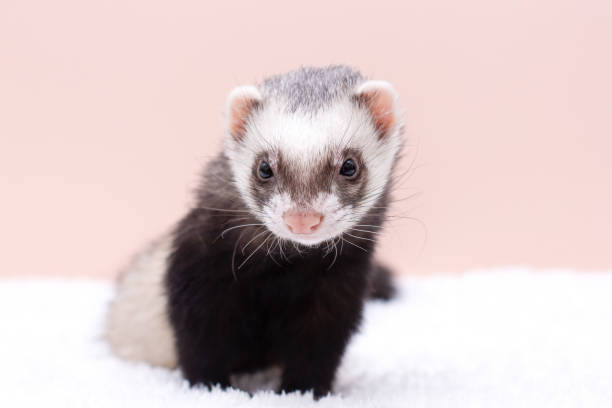
The domestic ferret (Mustela putorius furo) is a creature of captivating energy and surprising diversity. While behavior and personality often take center stage, the intricate tapestry of their colors, markings, and coat types—the result of both natural variation and careful breeding selection—is a complex and fascinating field of study. Identifying a ferret’s exact morphology requires understanding the interplay between three variables: Color (the hue of the guard hairs), Pattern (the distribution of that color), and Masking (facial markings).
This guide provides an exhaustive exploration of ferret coat morphology, with a dedicated focus on distinguishing the most common and often confused types: the robust Sables, the genetically unique Albinos, and the distinct pattern of Mitts.
I. The Genetic Architecture of Ferret Coloration
Ferret pigmentation is governed by the interaction of melanins, the pigments that provide color to hair, skin, and eyes. The intensity and distribution of these melanins—specifically eumelanin (dark/black/brown) and pheomelanin (red/yellow/cream)—determine the final visual phenotype.
A. Coat Anatomy and Terminology
To accurately classify a ferret, one must understand the three components of the coat:
- Guard Hairs: These are the long, coarse, outer hairs that provide structural coverage and determine the primary color (e.g., black, brown, red).
- Undercoat: The dense, soft, insulating layer directly beneath the guard hairs. Its color (often white, cream, or gold) significantly influences the overall tone or shading of the ferret. A heavily pigmented standard color ferret may have an undercoat that is nearly the same color as the guard hairs, while a dilute color (like Champagne) will have a stark contrast.
- Points: Areas of the body where color is most concentrated, typically the mask, the tail, the feet, and the legs. These areas are often darker due to temperature-sensitive enzymes (similar to the genetics found in Siamese cats).
B. The Influence of Molting and Seasonality
Identifying a ferret’s true color can be challenging due to seasonal molting. Ferrets shed their coats twice a year (spring and autumn).
- Winter Coat: Usually thicker, longer, and often appears lighter because the dense, pale undercoat dominates the visual field.
- Summer Coat: Typically shorter, sparser, and reveals more of the darker guard hairs, often making the ferret look one or two shades darker than in winter.
- Kits vs. Adults: Kits often have a darker, fuzzier “baby coat” which can take 6 to 12 months to fully transition into their adult color and pattern.
II. The Primary Ferret Color Spectrum: Defining the Base Hues
Ferret colors are broadly categorized based on the hue of the guard hair and the depth of pigmentation.
1. The Sable Complex (Black/Dark Brown Dominant)
Sable is the foundational, most common, and perhaps the most varied color group. It is characterized by dark pigmentation of the guard hairs contrasted with a lighter undercoat.
| HUE | Definition | Distinguishing Features |
|---|---|---|
| Standard Sable | Dark brown to black guard hairs with a deep cream or white undercoat. | High contrast. Distinct, dark T-shaped or V-shaped mask. Points (tail, feet) are noticeably darker than the body. |
| Black Sable | Guard hairs are true, deep black (not brown). The undercoat may be white or very light cream. | Maximum intensity. Very dark points and a sharp, well-defined black mask. Often appears nearly black when wet or close-up. |
| Chocolate | A softening of the Sable color; the guard hairs are mid- to rich-brown. | Medium contrast. The nose is often pink-brown or brick-colored. Mask is present but brown, not black. |
2. The Dilute Complex (Red/Cream Dominant)
Dilute colors result from a genetic modification that reduces the amount or intensity of eumelanin (black/brown) and allows pheomelanin (red/cream) to express more freely.
| HUE | Definition | Distinguishing Features |
|---|---|---|
| Champagne | Guard hairs are light tan, biscuit, or pale fawn. Undercoat is typically white or off-white. | Low contrast. The overall appearance is soft and muted. Nose is beige or pink. Eyes are typically burgundy or light brown. |
| Cinnamon / Red | Guard hairs show a distinct reddish-brown, copper, or mahogany tone. | Unique reddish hue. Mask is weak or non-existent, often just a slight shading around the eyes. |
| Silver | Guard hairs are an even mix of white and black hairs, creating a frosted, silvery effect. | Guard hairs are often tipped with silver-white. Usually a minimal mask. |
3. The Albino Complex (Absence of Pigmentation)
Albino ferrets are not a color but a genetic condition resulting from the total lack of melanin production (ocular albinism).
| HUE | Definition | Distinguishing Features |
|---|---|---|
| Albino | Pure white, non-pigmented guard hairs and undercoat. | Crucially defined by the eyes: distinctive pink or ruby-red eyes. Nose is always bubblegum pink. No mask or points of color whatsoever. |
| Dark-Eyed White (DEW) | The coat is entirely white or ivory, visually similar to an Albino, but retaining dark pigmentation in the eyes. | Black or dark brown eyes. Nose is typically pink, but sometimes speckled or brownish. This is a pattern (often a heavily marked Self or Roan pattern) layered over a color, not a true Albino. |
III. Identifying Markings and Patterns: Focus on Mitts and Beyond
While color defines the hue, the pattern defines where that color is distributed. Patterns are often the most difficult element to standardize, as they can range from solid color coverage to highly abstract patches.
A. Standardized Patterns
These patterns determine the uniformity of coat color across the body:
- Solid: Uniform color across all guard hairs, undercoat, legs, and tail. The contrast between guard hairs and undercoat is minimal, resulting in a deep, saturated color. Very rare in Sable; more common in Black or Dark Chocolate. Masking is generally absent.
- Standard Point: The foundational pattern. Color is concentrated heavily on the points (feet, tail, legs) and the mask, with the color gradually lightening toward the body and shoulders. Most Sables and Chocolates fall into this category.
- Roan: Defined by having 50-60% white guard hairs evenly interspersed throughout the colored areas. This creates a highly frosted, salt-and-pepper appearance. A “Roan Solid” means the color is evenly spread, while a “Roan Point” means the frosting is concentrated on the points.
B. The Mitt Pattern: Symmetrical Elegance
The Mitt is a pattern characterized by symmetrical white feet, resembling little socks or mittens.
Definition of a True Mitt
A ferret is classified as having the Mitt pattern when:
- Symmetry: The white markings appear on all four paws. While the extent might vary slightly, they must be prominent on all four.
- Coverage: The white extends from the toes up the leg to at least the ankle or wrist, but typically not past the knee or elbow (which would push it toward a specialized pattern like Badger).
- Contrast: The mitts must be a sharp, clear white, contrasting distinctively with the base color (e.g., a Black Sable Mitt, a Champagne Mitt).
Elaboration on Mitt Variations
The Mitt pattern is often combined with other patterns or colors:
- Solid Mitt: A ferret with a solid color concentration on the body but possessing white mitts.
- Color Mitt: Used to describe the majority of mitts, where the ferret displays a pointed pattern (mask, dark tail) but also the specific white feet.
- Misidentification Caution: A very pale undercoat showing through sparse guard hairs on the feet does not constitute a Mitt pattern. The white must be defined by white guard hairs/pigmentation in that specific area.
IV. Specialized and High-Contrast Patterns
These patterns are defined by substantial white markings on the body, head, or tail, and often carry complex genetic implications.
1. The Blaze Pattern
The Blaze is one of the most striking and genetically significant patterns. It is characterized by a long, narrow white stripe running from the top of the head (between the ears) down the back of the neck.
- Key Features: Must have the white head stripe. Often accompanied by a white bib/collar, white mitts, and a white tip on the tail. The blaze itself can be narrow (pencil stripe) or wide.
- Color Base: Blaze is a pattern that can overlay any color (e.g., Sable Blaze, Champagne Blaze).
- Genetic Warning: Ferrets with the Blaze pattern, along with Pandas and DEWs (discussed below), are genetically linked to a condition similar to Waardenburg Syndrome in humans. This syndrome often results in congenital deafness, particularly in ferrets with extensive white markings on the head.
2. The Panda Pattern
The Panda pattern focuses on heavily reduced color pigmentation in the head and neck area.
- Key Features: A white or nearly white head, including a full white hood that covers the area from the nose to behind the ears. The eyes may be bordered by small, dark patches, or the entire face may be devoid of color.
- Body Color: The body, tail, and legs retain their base color (e.g., a Black Panda, where the body is black).
- Mitts: Mitts are mandatory in most Panda classifications.
- Genetic Warning: Like the Blaze, Pandas often carry an increased risk of congenital deafness due to the dominant white gene involved in the patterning.
3. The Badger Pattern
While sometimes confused with the Blaze, the Badger pattern is defined by two symmetrical white stripes that run down the face, often starting above the eyes and continuing back towards the neck.
- Key Features: Distinct eye-stripes that mimic the facial markings of a true badger. The body usually retains a standard pointed pattern.
- Rarity: This pattern is less frequently seen and is typically considered a variant of the dominant white patterns.
V. Deep Dive: The Core Identification Types
With the foundational knowledge of colors and patterns established, we can now focus on the three requested types, detailing their specific points of identification.
1. The Sable Complex: The Archetypal Ferret
Sable is the most prevalent color and often serves as the “standard” against which all other colors are measured.
A. Identification Criteria for Standard Sable
| Feature | Standard Sable | Black Sable |
|---|---|---|
| Guard Hairs | Dark to rich brown; black tips are common. | True, deep black throughout; no brown tone visible in direct light. |
| Undercoat | Cream, tan, or white; creates high visual contrast. | White or faint cream; contrast is maximized, giving a stark black and white appearance. |
| Masking | Prominent “T” or “V” shaped mask, dark brown. | Sharp, coal-black mask, intensely defined. |
| Nose Color | Brown, often with a subtle “T” outline of darker brown or black pigment. | Solid black, gunmetal gray, or heavily speckled black/pink. |
| Eye Color | Dark brown or black. | Black (the darkest possible iris). |
| Overall Impression | Classic wild look. Appears two-toned due to the light undercoat. | Very dark, saturated color intensity. Very little variation in shading across the back. |
B. The Siamese Sable Variation
This term describes a specific pattern within the Sable complex where the points are unusually dark and distinct, mimicking the high contrast of a Siamese cat. The points (mask, legs, tail) are extremely dark, while the body color fades noticeably to a lighter beige or cream. This is typically observed in ferrets with a very high contrast between guard hair and undercoat.
2. Recognizing the True Albino
Albino ferrets are perhaps the easiest to identify due to their defining genetic trait: the total absence of melanin, which affects the eyes, coat, and skin.
A. Criteria for True Albino Identification
- Coat Color: Must be pure, unblemished white. Any yellowing is often due to age, environmental staining, or diet, but the base pigmentation is white. There should be no dark guard hairs, not even on the tail or legs.
- Eye Color: The definitive trait. The eyes must be pink or ruby-red. The red appearance is not pigment but the reflection of light off the blood vessels in the retina, which would normally be obscured by melanin.
- Nose Color: Always a bubblegum or light sugar-pink. No speckles, no brown, no black outline.
- Genetic Implication: Albinism is a recessive trait. True Albinos do not suffer from the congenital deafness associated with the dominant white patterns (like Blaze or Panda).
B. Distinguishing Albino from Dark-Eyed White (DEW)
This distinction is critical and often confused by owners.
| Feature | True Albino | Dark-Eyed White (DEW) |
|---|---|---|
| Eye Color | Pink/Red (Blood vessel visible) | Black or very dark brown. |
| Coat Pigment | Zero melanin (White is the absence of color). | Presence of some melanin pigment (often a heavily frosted and diluted pattern layered over a dark color). |
| Nose Color | Pure pink. | Pink, often speckled, tan, or brownish. |
| Health Link | No link to congenital deafness. | Strong genetic link to Waardenburg syndrome and potentially deafness. |
3. The Mitt Pattern: Focusing on the Feet (Mitt Identification)
Mitts are a pattern marker that can be overlaid on virtually any color base (Sable Mitt, Champagne Mitt, Chocolate Mitt).
A. The Definition of Symmetrical White Mitts
The primary identification point for the Mitt pattern is the clear, symmetrical presence of white on all four paws.
- Extremity: The white must be clean and clearly delineated from the colored fur above it. The line where the color stops and the white begins must be relatively sharp. Fading color leading to a pale foot does not count.
- Socks/Stockings: Mitts are generally symmetrical “socks.” If the white extends far up one leg (past the elbow) but only covers the toes on the other, the ferret may be classified as having a Mismatch pattern or a Partial Mitt rather than a classic Mitt.
- Bib/Collar Correlation: Ferrets with the Mitt pattern frequently display a small white bib (a patch of white under the chin) or a slightly extended neck patch. This is often a co-factor in the expression of the Mitt pattern gene.
- Head Masking: Mitts are compatible with a full, dark mask (Sable Mitt) or a very light or absent mask (Champagne Mitt). The mitts define the feet, not the face.
VI. Practical Guide to Ferret Color Assessment
To classify a ferret accurately, a systematic approach is necessary, focusing on the three pillars of morphology: Color, Pattern, and Special Markings.
Step 1: Determine the Base Color (Guard Hair/Undercoat)
- Inspection: Spread the fur widely, especially on the neck and back, to see the ratio of guard hair to undercoat.
- Lighting: Use natural daylight. Artificial lighting (especially yellow incandescent) can dramatically skew the perception of Sable (making it look reddish) and Champagne (making it look white).
- Question: Is the guard hair predominantly black/dark brown (Sable), mid-brown (Chocolate), or light tan/fawn (Champagne)? Is the undercoat highly contrasting (Pointed) or matching (Solid)?
Step 2: Examine the Points and Masking
- Mask: Is the mask dark and prominent (Sable)? Is it weak or nonexistent (Champagne, Cinnamon)? Is the head entirely white (Panda)?
- Points: Are the legs and tail significantly darker than the body? If so, the ferret is “pointed.” If the color is solid/even across the body, it may be a Solid or Roaned Solid.
Step 3: Identify Specific Markings (Mitts, Blaze, Roan)
- Check the Feet: Are all four paws symmetrically white? If yes, classify it as a [Color] Mitt.
- Check the Head: Is there a white stripe down the head? If yes, it is a [Color] Blaze. Is the entire head white? If yes, it is a [Color] Panda.
- Check the Body: Does the ferret look frosted or flecked, with white hairs mixed throughout the colored zones? If so, it is a [Color] Roan.
Step 4: Final Classification
The final classification follows a specific order: Color + Pattern + Markings.
- Example 1: A dark brown ferret with a full mask, dark points, and symmetrical white feet: Sable Mitt.
- Example 2: A ferret with a light tan base, a faint mask, and no special markings: Champagne Point.
- Example 3: A pure white ferret with dark eyes: Dark-Eyed White (DEW).
VII. Conclusion: The Beauty and Diversity of the Ferret Coat
The domestic ferret’s coat is a testament to the diverse expression of mammalian genetics. From the high-contrast drama of the Black Sable to the purity of the Albino and the refined symmetry of the Mitt pattern, each phenotype contributes to the unique aesthetic appeal of the species.
Accurate identification is not simply a matter of nomenclature; it is essential for responsible breeding (particularly to avoid doubling up on the dominant white patterns associated with deafness) and for fostering a deeper appreciation for the subtle distinctions that make each ferret a unique individual. While coat colors may change with the seasons and age, a practiced eye focusing on the foundational elements of guard hair, undercoat, points, and specific white markings will ensure precise classification.
#FerretIdentification #FerretColorGuide #SableVsBlackSable #AlbinoFerretCare #FerretMarkingsExplained #FerretCoatTypes #PetFerretGuide #FerretGenetics101 #FerretHacks #ExoticPets #HowToIdentifyFerretColors #FerretColors #SableFerret #AlbinoFerret #FerretMitts #FerretGenetics #MustelaPutoriusFuro #FerretLove #FerretCommunity #ExoticPet #FerretFacts #FerretPatterns #BlazeFerret #PandaFerret #DEWFerret #PetCareGuide #KnowYourFerret #FerretsOfInstagram #WeaselWednesday
Add comment