

The domestic dog (Canis familiaris) is a master communicator, relying extensively on a complex lexicon of non-verbal signals involving posture, tail carriage, gaze, and vocalization. However, few morphological features influence the clarity and interpretation of canine behavior as fundamentally as ear carriage.
The difference between the erect, highly mobile ear of the ancestral wolf and primitive dog breeds, and the drooping, often obscured ear of many modern breeds, is not merely aesthetic. It represents a significant variation in the communicative bandwidth available to the animal. This elaborate guide delves into the evolutionary roots, biological constraints, and specific behavioral nuances that differentiate communication in dogs with erect ears (e.g., Huskies, German Shepherds) versus those with floppy or pendulous ears (e.g., Beagles, Labrador Retrievers).
I. Evolutionary Foundations: The Domestication Syndrome and Morphological Shifts
To understand the communicative differences, one must first explore why floppy ears exist at all. The shift from the ancestral erect ear—the standard form across the genus Canis—to the pendulous ear is a hallmark of the Domestication Syndrome.
The Neural Crest Cell Theory
During the process of domestication, selective pressure for tameness inadvertently affected several seemingly unrelated traits, including coat color, shorter muzzles, reduced brain size, and the relaxation of the auricular cartilage. This phenomenon is theorized to stem from changes in the embryonic neural crest cells.
These pluripotent cells migrate throughout the developing embryo, influencing the formation of nervous tissue, pigment cells, and cartilage. When selection favored reduced flight response and lower stress hormone (cortisol) production—key indicators of “tameness”—it indirectly resulted in minor developmental defects or reduced proliferation in neural crest cells. Since auricular cartilage is a neural crest derivative, a slackening of the cartilage structure renders the ear unable to stand fully erect, resulting in the floppy or semi-pendulous state known as neoteny (the retention of juvenile features into adulthood).
The Musculature of Movement
Erect-eared dogs possess a finely tuned set of intrinsic and extrinsic pinna muscles (auricular muscles) that allow for nearly 180 degrees of rotational movement. This complex motor unit recruitment enables the dog to perform subtle, highly specific adjustments that convey everything from mild curiosity to intense threat.
In contrast, while floppy-eared dogs retain these underlying muscles, the sheer weight and structure of the pendulous cartilage significantly restrict the functional range of motion. The signal is either dampened, structurally obscured by the flap itself, or requires a far greater exertion of muscular energy to produce a discernible shift.
II. The Erect Ear Model: Clarity and High-Definition Signaling
Erect ears, characteristic of breeds like the Malamute, Shiba Inu, Malinois, and most terriers, function as highly effective, visible indicators of internal state. They provide what can be described as “high-definition” communication due to their visibility and responsiveness.
A. The Baseline and Range of Motion
The neutral position for an erect ear is typically forward-facing and slightly relaxed, constantly scanning the environment. From this baseline, the ear can articulate into three primary axes of movement, each communicating a clear emotional state:
1. Forward and Tense (Alertness, Concentration, or Threat)
When a dog is highly engaged, interested, or contemplating action, the ears pivot forward, often aligning with the eyebrow ridge.
- Subtle Variation (Concentration): The ears may orient slightly independently—one forward toward a sound, the other maintaining peripheral awareness. This indicates focused attention without immediate commitment to action.
- Subtle Variation (Threat/Aggression): When paired with a hard stare, lowered head, and raised hackles, the ears become rigid, sometimes even slightly cupped forward (like a satellite dish). The skin over the skull tightens, recruiting all available cephalic musculature. This is a clear, unambiguous signal of impending escalation.
2. Lateral Rotation (Uncertainty or Inquiry)
Ears rotated laterally, often referred to as “airplane ears” or “relaxed pinning,” indicate mild uncertainty, a questioning attitude, or a willingness to engage socially. This is common when greeting a familiar dog or human inquisitively.
3. Pinned Back/Flat Against the Head (Appeasement, Fear, Pain)
This is arguably the most crucial appeasement or fear signal. The ears are actively pulled backward and plastered flat against the skull.
- Subtle Variation (Active Submission/Appeasement): If the ears are pinned but the rest of the body is soft (low crouch, loose tail wag), the dog is actively requesting cessation of perceived threat or soliciting interaction.
- Subtle Variation (Fear/Pain): If the ears are intensely pinned, the forehead is furrowed, and the eyes are wide (whale eye), the dog is experiencing acute distress, fear, or pain. The retraction aims to protect the highly sensitive inner ear structure while simultaneously making the dog appear smaller and less threatening.
Erect ears allow an observer—human or canine—to detect even a twitch of tension in the underlying muscles, providing instant feedback on the dog’s emotional processing speed.
III. The Floppy Ear Model: Muffled Signals and Communication Compensation
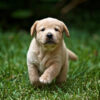
Floppy ears, common in hunting and companion breeds (e.g., Cocker Spaniels, Basset Hounds, Golden Retrievers), present a fundamental constraint on the visual signaling potential. The reduced mobility introduces variance and ambiguity, necessitating greater reliance on compensatory body language.
A. The Challenge of Visibility
The physical structure of the floppy ear—often long, heavy, and covered in dense fur—muffles the subtle communicative movements that are so prominent in erect-eared dogs.
1. Reduced Range of Tension
While a floppy-eared dog can still activate its auricular muscles to pull the ears back, the movement often translates mainly into cranial tension rather than visible pinna movement.
- The Muffled Signal of Fear: When a Lab or Beagle pins its ears in fear, the movement registers primarily as the ear flap pressing slightly harder against the neck and the skin wrinkling above the eyes. This is far less immediately apparent than the stark, flat profile of a pinned erect ear.
- The Invisibility of Alertness: An erect ear announces alertness by snapping forward. A floppy ear, when alert, may slightly shift, but the primary visual cue must shift to the eyes (widening, intent gaze) or the muzzle (slight tension).
2. The Neotenic Mask
Floppy ears contribute heavily to the overall neotenic appearance—the “perpetual puppy” look that humans find overwhelmingly appealing. While beneficial for human bonding, this mask can cause communication issues between dogs. The floppy ears dampen or entirely hide signals of threat and tension, making the dog appear perpetually benign or juvenile.
- Risk of Misinterpretation: An erect-eared dog approaching a floppy-eared dog (e.g., a Husky approaching a Cavalier King Charles Spaniel) may find the spaniel’s tension signals (which rely heavily on subtle eye shifts and slight cranial movement) too muted or invisible. The erect-eared dog might perceive the floppy-eared dog as unresponsive, failing to acknowledge its social cues, or even failing to read the threat, which can lead to rapid escalation.
B. Compensatory Communication Strategies
Since primary ear signaling is structurally constrained, floppy-eared breeds demonstrate an increased reliance on other channels to ensure their intentions are understood:
1. Exaggerated Tail Carriage and Movement
Floppy-eared dogs often exhibit highly expressive, broad, and rapid tail wags. The tail becomes the primary gauge of internal state, with the breadth and speed compensating for the lack of delicate ear articulation.
2. Enhanced Facial Expression
Muscles governing the eyes and muzzle must work harder. These dogs often have more pronounced “eyebrows” (the orbital region) which articulate tension and sadness. The lip lick and yawn—as stress signals—may be employed more frequently or with greater theatricality to convey unease.
3. Increased Vocalization
Hounds, in particular, rely heavily on vocal communication (baying, howling, whining) to communicate their state and location. This reliance on auditory cues may partially compensate for the deficiencies in the visual communication channel.
IV. Intermediate and Varied Ear Types
Not all dogs fall into the strict “erect” or “floppy” dichotomy. Other ear carriages introduce their own specific communication nuances:
A. Rose and Button Ears
Breeds like the Greyhound (rose ear) or many Terriers and Collies (button/semi-erect) have ears that fold over but retain significant rotational capacity at the base.
- Communication Advantage: These ears often function as a compromise. While they do not provide the stark, clear delineation of an erect ear (the tip is always down), they maintain the ability to show tension and direction. For instance, a Collie’s ear can pivot back and flatten powerfully against the head during fear, or snap forward to indicate intense focus, utilizing the visible crease of the fold to amplify the movement.
B. Cropped Ears (Human Intervention)
The practice of ear cropping (e.g., Dobermans, Boxers, Schnauzers) artificially transforms a floppy or semi-floppy ear into an erect one.
- Ethical and Behavioral Implications: From a communicative standpoint, cropping undeniably increases the clarity of signaling. A cropped Doberman has a much higher bandwidth for displaying subtle tension and threat than the natural floppy-eared Doberman progenitor. However, this clarity comes at the cost of ethical concerns and the potential over-clarification of signals—a dog may appear more intimidating or aggressive than its natural conformation would suggest simply because its signs of alertness are now visually amplified.
V. Inter-Canine Communication Dynamics: When Structures Clash
The most critical variations in communication arise when dogs of differing ear morphology interact.
A. Erect-Eared Dogs Interacting with Each Other
Communication is typically highly efficient and rapid. Signals are exchanged quickly, and even slight adjustments in pinna tension can dictate the social choreography. This efficient exchange is adaptive for pack living, where quick, clear feedback is essential for maintaining social hierarchy and coordination.
B. Floppy-Eared Dogs Interacting with Each Other
These interactions rely heavily on the holistic evaluation of the body. Dogs must observe the full posture—the height of the neck, position of the tail, speed of approach, and tightness of the lips—because the ears offer minimal immediate data. This often results in communication that appears more fluid, with frequent checks and rapid shifts in proximity, as both parties seek the full context.
C. The Erect-Floppy Mismatch (The Risk Zone)
This scenario poses the highest risk for ambiguity:
- The Muffled Warning: A dominant erect-eared dog displays forward tension through its ears and gaze, signaling “stop” or “respect space.” The floppy-eared dog, while stressed, registers its fear internally (increased heart rate, shallow breathing) and attempts to signal appeasement by pulling its ears slightly back. This subtle movement is often invisible to the erect-eared dog.
- The Perceived Neutrality: The erect-eared dog sees a dog whose ears are essentially neutral (just hanging down) and interprets this as a lack of deference or even neutral intent. This misreading can prompt the erect-eared dog to escalate the threat, believing its initial warning was ignored.
- Delayed Response: Because the floppy-eared dog’s primary signal is subdued, it must rely on slower compensatory signals (like turning the body sideways or licking the lips) to convey deference, which may be too late to prevent conflict initiated by the fast-reading erect-eared dog.
In essence, the floppy ear introduces latency into the visual communication system, requiring both dogs to work harder to verify signals.
VI. Human Interpretation and Anthropomorphism
Humans often interact with dogs based on an anthropomorphic interpretation of the dog’s appearance, and ear carriage plays a significant role in this bias.
A. The “Vulnerable” Floppy Ear
Humans tend to perceive floppy-eared dogs as perpetually friendly, less threatening, and more appealingly vulnerable (the neotenic effect). This can lead to dangerous human overconfidence, especially when interacting with large, traditionally “soft” breeds like the Labrador. A stressed Lab’s low-key ear signals and soft facial structure might be misread as compliance or relaxation, causing the human to ignore subtle signs of discomfort that an erect-eared breed would make visibly obvious.
B. The “Aggressive” Erect Ear
Conversely, erect-eared breeds (or cropped breeds) are often perceived as inherently more alert, assertive, or aggressive, even when relaxed. Their clear signaling of alertness (ears forward) can be misread by humans as immediate threat, leading to unnecessary fear or cautious handling. The dog’s efficient communication is paradoxically interpreted as increased hostility.
C. The Importance of Cranial Tension
For humans trained in canine behavior, reading a floppy-eared dog requires discounting the pinna movement and focusing entirely on cranial tension and the orbital region. The tightening of the skin over the forehead, the furrowing above the eyes, and even the subtle rotation of the head become the critical indicators of emotional state—skills that must be actively learned, unlike the intuitive reading of an erect ear.
VII. Conclusion: The Holistic View of Canine Communication
The variation between floppy and erect ears highlights that canine communication is not a universal language but a dialect shaped by selective breeding and morphology.
Erect ears provide a clean, high-bandwidth channel for transmitting rapid, nuanced signals of emotional state, necessary for efficient intra-pack communication. Floppy ears, a byproduct of domestication and neoteny, reduce this channel’s clarity, forcing the dog to compensate through exaggerated movements of the tail and body, and a heightened reliance on facial expressions and vocalization.
Understanding these structural constraints is paramount for responsible ownership and accurate behavioral assessment. It moves the observer beyond focusing solely on what a dog is doing and forces consideration of how clearly that action can be perceived by others, ultimately promoting safer and more accurate interspecies understanding. Canine behavior cannot be read solely through a single lens; it requires a comprehensive, holistic evaluation that contextualizes morphology within the overall communicative matrix.
#DogCommunication #DogBehavior #FloppyEars #ErectEars #CanineScience #DogBodyLanguage #DecodingDogs #DogSignals #CanineMorphology #DomesticationSyndrome #DogTrainingTips #PetBehavior #BreedSpecifics #HuskyEars #LabradorLife #DogFacts #VeterinaryBehavior #AnimalScience #UnderstandingDogs #EvolutionOfDogs






Add comment