
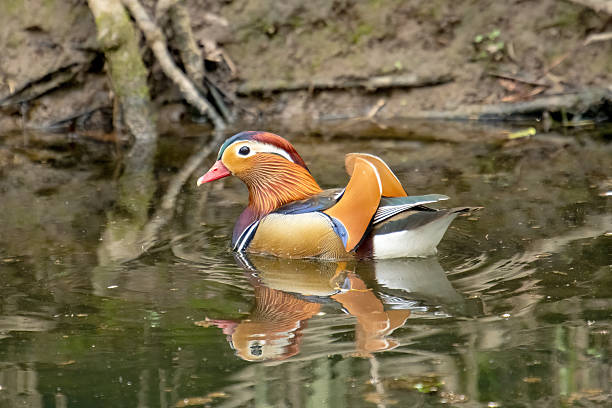
The Mandarin Duck and the Wood Duck are two of the most charismatic members of the Anatidae family. Though they belong to the same genus (Aix), each species has evolved a distinct set of adaptations that make it a favorite of aviculturists, wildlife photographers, and conservationists alike.
- Mandarin Duck – Aix galericulata – a striking, Asian native best known for the male’s flamboyant plumage, intricate courtship displays, and a tendency to thrive in temperate‑subtropical woodlands and rice‑paddy ecosystems.
- Wood Duck – Aix sponsa – North America’s most ornate diving duck, renowned for its vibrant “bills” (the male’s colorful bill and the female’s iridescent head) and a strong preference for wooded wetlands and riparian habitats.
Both ducks are cavity‑nesting waterfowl that readily use artificial nest boxes, making them amenable to captive breeding. Their popularity stems not only from their visual appeal but also from a unique blend of moderate egg production, good foraging ability, and a relatively calm disposition when raised from ducklings.
This handbook compiles the latest scientific knowledge, husbandry best‑practices, and nuanced breeding tips for the advanced keeper. It is divided into parallel sections for each species, followed by comparative tables and a set of Frequently Asked Questions.
2. Other Names & Synonyms
| Mandarin Duck | Wood Duck |
|---|---|
| Common Names | Common Names |
| 1. Mandarin | 1. Wood Duck |
| 2. Mandarin Drake | 2. Bufflehead (occasionally misapplied) |
| 3. Chinese Duck | 3. “Bubbler” (regional US slang) |
| 4. Mandarin Swan (historical) | 4. “Cedar‑bill” (old North‑American term) |
| Scientific Synonyms | Scientific Synonyms |
| Anas galericulata (Linnaeus, 1766) – original classification | Anas sponsa (Linnaeus, 1766) – original classification |
| Mergus galericulatus – early 19th c. texts | Mergus sponsus – early 19th c. texts |
| Local/Regional Names | Local/Regional Names |
| “Yàn yàn” (Chinese) – “flame‑swallow” | “Buffle‑head” (Southern US) – not to be confused with Bufo sp. |
| “Kāyū” (Japanese) – “fire‑bird” | “Bub‑bucker” (early settlers) |
3. Primary Breed Purpose
| Purpose | Mandarin Duck | Wood Duck |
|---|---|---|
| Ornamental / Show | Highly prized in aviaries for striking plumage; standard in exhibition classes worldwide. | Popular in waterfowl shows; prized for iridescent head and “bill” colors. |
| Egg Production | Low‑moderate (30‑45 eggs/season); mainly for breeding programs, not commercial egg sales. | Slightly higher (45‑60 eggs/season) under optimal conditions; still not an “egg‑layer” breed. |
| Foraging / Pond Management | Excellent dabblers/divers; help control aquatic vegetation and insect larvae. | Strong divers; often used in natural pond restoration to aid in seed dispersal. |
| Conservation Breeding | Frequently used in re‑introduction projects across Europe & Asia. | Core species for North‑American wetland restoration and captive‑release initiatives. |
4. Physical Characteristics
4.1 Mandarin Duck
| Feature | Male | Female |
|---|---|---|
| Overall Size | 46 cm (18 in) length; 850 g (1.9 lb). | 45 cm (17.5 in); 720 g (1.6 lb). |
| Plumage | • Crimson “saddle” on back. • Emerald green head with white “whiskers.” • Black “mask” across eyes, bright orange “bill” with black tip. • Long, pointed tail feathers (up to 10 cm) with iridescent blue‑green tips. |
• Subtle brown‑gray mottled back, white cheeks, dark eye‑stripe, and a modest “saddle.” • Orange bill, less flamboyant; brownish head with white speckles. |
| Feet | Dark gray, webbed; short. | Similar to male, slightly paler. |
| Sexual Dimorphism | Extreme – male is a “living jewel.” | Moderate – female is cryptic, aiding nest concealment. |
4.2 Wood Duck
| Feature | Male | Female |
|---|---|---|
| Overall Size | 48 cm (19 in) length; 950 g (2.1 lb). | 46 cm (18 in); 760 g (1.7 lb). |
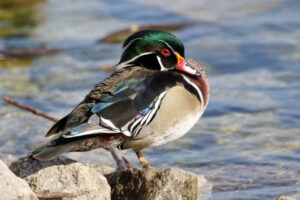
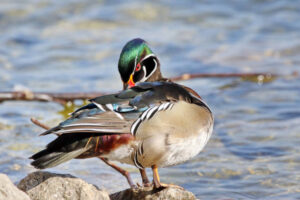
| Plumage | • Iridescent green head with white “cap.” • Bright red “bill” with black “saw‑tooth” edge. • Chestnut “saddle,” black “scutes” on sides, white “neck band.” • Long, pointed tail feathers (up to 12 cm). |
• Gray‑brown head with white “cheeks.” • Dark orange‑brown bill with black tip. • Subtle “saddle” pattern; overall cryptic. |
| Feet | Bright orange‑yellow, strongly webbed. | Similar but slightly duller. |
| Sexual Dimorphism | Very pronounced – male is one of the most colorful waterfowl on Earth. | Female is camouflaged for nesting, with a muted palette. |
Both species possess a broad, rounded bill suited for dabbling and a moderately deep keel for strong flight, albeit with limited endurance due to their heavy plumage.
5. Weight & Growth Curve
| Age (days) | Mandarin Duck (g) | Wood Duck (g) |
|---|---|---|
| Hatch‑0 | 19–22 | 20–23 |
| 7 | 35–42 | 38–44 |
| 14 | 55–66 | 62–73 |
| 21 | 78–92 | 84–100 |
| 28 | 110–128 | 118–138 |
| 35 | 150–170 | 158–180 |
| 42 | 190–215 | 200–230 |
| 49 | 230–260 | 240–275 |
| 56 (≈8 weeks) | 260–295 (sex‑dependent) | 280–320 (sex‑dependent) |
| 90 (≈3 months) | 350–380 g (female) / 380–410 g (male) | 380–410 g (female) / 420–460 g (male) |
| 180 (≈6 months) | 560–620 g (female) / 620–680 g (male) | 620–680 g (female) / 680–760 g (male) |
Key growth points
- First two weeks: Rapid feather development; brood‑patch is fully functional.
- Weeks 3‑4: Transition from water‑dependent to on‑land foraging; introduction to high‑protein starter feed (20 % protein).
- Weeks 5‑8: Molting of down to juvenile feathers; weight gain slows as feathers provide insulation.
- Months 3‑6: Full flight feather development; birds are ready for limited flight training in an enclosed aviary.
- Month 9+: Reach adult size; sexual maturity typically occurs between 8‑10 months, but first viable clutches may not appear until 12‑14 months.
6. Climatic Tolerances
| Parameter | Mandarin Duck | Wood Duck |
|---|---|---|
| Native Climate | Temperate‑subtropical (East Asia: China, Japan, Siberia). | Temperate‑continental (Eastern North America). |
| Temperature Range (°C) | 5 – 30 °C (comfortable); tolerates down to –10 °C with shelter. | 0 – 28 °C; can endure –15 °C with adequate insulation. |
| Humidity | Prefers moderate‑high (60‑80 %); tolerates dryer winters if water access is assured. | Thrives in high humidity wetlands; can handle 30‑50 % during breeding if water is available. |
| Altitude | Up to 1,800 m (e.g., Himalayan foothills). | Up to 1,200 m (Appalachian Mountains). |
| Seasonal Adaptations | Winter plumage: Slightly duller, increased feather density. Behavior: Often forms small flocks in protected marshes. |
Winter: Increased reliance on sheltered ponds; may form mixed-species flocks with mallards. |
| Recommended Captive Climate | Indoor heated winter house (15 – 20 °C) + outdoor pond (spring‑fall). | Outdoor pond with windbreaks; heated water feature for winter, ambient 5 – 20 °C. |
Both species are excellent candidates for indoor‑outdoor rotational housing, provided a secure, predator‑proof water source is present year‑round.
7. Reproduction & Egg Production
7.1 Nesting Biology
| Feature | Mandarin Duck | Wood Duck |
|---|---|---|
| Nesting Site | Tree cavities (natural or artificial nest boxes, 45‑60 cm depth). | Same – prefers slightly deeper boxes (50‑70 cm) near water. |
| Nest Box Size | 18 × 18 × 30 cm (floor × floor × height) for a single pair; add 5 cm side clearance. | 20 × 20 × 35 cm recommended. |
| Incubation Period | 28‑30 days (average 29). | 28‑30 days (average 29). |
| Clutch Size | 7‑12 eggs (average 9). | 9‑12 eggs (average 10). |
| Egg Dimensions | 5.2 × 3.9 cm; 55‑65 g. | 5.5 × 4.0 cm; 58‑68 g. |
| Egg Appearance | Cream‑white with speckled brown spots; glossy surface. | Pale cream, often with faint brown speckles. |
| Breeding Season | Late February – early June (depends on latitude). | Mid‑March – July (peak May). |
| Mating System | Monogamous within a season; pair bonds may last multiple years. | Similar; high site fidelity to nest boxes. |
| Parental Care | Both parents incubate; female primarily tends young after hatching; male guards nest entrance. | Both share incubation; female broods; male guards territory, especially from predators. |
7.2 Egg Production Metrics
| Metric | Mandarin Duck | Wood Duck |
|---|---|---|
| First‑Year Clutch | 6‑8 eggs (sub‑optimal due to immaturity). | 8‑10 eggs. |
| Peak Production | 30‑45 eggs per season (3‑4 clutches). | 45‑60 eggs per season (4‑5 clutches). |
| Egg Viability | 78‑85 % hatchability under optimal conditions. | 80‑88 % hatchability. |
| Factors Influencing Output | Photoperiod, diet (protein ≥ 20 % pre‑lay), nest box quality, stress levels. | Same, plus water quality (chlorine < 0.5 ppm). |
Both species are not commercially viable egg layers but are prolific enough for small‑scale breeding projects and hobbyist show programs.
8. Flying Ability
| Aspect | Mandarin Duck | Wood Duck |
|---|---|---|
| Flight Style | Strong, direct flaps with a brief glide; slightly “bobbing” due to heavy plumage. | Fast, agile; capable of short bursts of high speed (up to 80 km/h). |
| Take‑off | Requires a running start on water or a short runway; prefers low wind. | Can launch from a standing start on land; excels at “steep‑angle” take‑off. |
| Endurance | Moderate – 2‑3 km of sustained flight before needing rest. | Slightly higher – 3‑4 km. |
| Maneuverability | Good in wooded environments; adept at navigating through dense canopy. | Excellent – excels at weaving through narrow reeds and branches. |
| Winter Flight | Often migrates short distances to milder coastal wetlands. | Mostly resident; occasional local migrations to warmer ponds. |
| Training Tips | Use a flight tunnel of 5‑7 m, gradually increase length; provide a “perch‑to‑water” slope for confidence. | Begin with “flight fence” (low‑height net) and reinforce with positive reinforcement (treats). |
Both species are capable fliers; however, in captive environments they often become flight‑restricted for safety, especially when housed near domestic poultry.
9. Breed History & Origin
| Species | Historical Timeline |
|---|---|
| Mandarin Duck | Pre‑historic – Fossil record shows Aix lineage dating back 6 Myr in East Asia. 5th‑6th Century CE – Depicted on Chinese porcelain and Japanese scrolls as a symbol of fidelity. 1700s – Introduced to European aristocratic menageries (e.g., Versailles, Schönbrunn). 1870s – First captive breeding programs in England; “Mandarin Club” formed. Early 1900s – Exported to the United States; used in waterfowl shows; population declined in native range due to habitat loss. 1990s‑present – Conservation re‑introduction in Japan, Korea, and the Russian Far East. |
| Wood Duck | Pre‑colonial – Indigenous North American peoples revered it for its bright plumage; often featured on tribal textiles. 1700s – First scientific description by Linnaeus (1766). 1800s – Over‑hunting for feathers caused population crash; near‑extinction by 1900 (≈ 500 breeding pairs). 1905‑1910 – David O. Thomas and John M. McCarthy established the first captive breeding program in Pennsylvania. 1930s – Release of > 5,000 captive‑bred birds; population rebound. 1970s‑present – Designated a “species of greatest conservation need” in many US states; heavily used in wetland restoration. |
Both ducks have become cultural icons: the Mandarin as a symbol of love and fidelity in East Asia, the Wood Duck as a North‑American emblem of wild waterfowl beauty.
10. Life Expectancy
| Stage | Mandarin Duck | Wood Duck |
|---|---|---|
| In Wild | 6‑8 years (average), up to 12 years (rare). | 5‑7 years (average), up to 10 years. |
| In Captivity (optimal care) | 10‑14 years; some individuals documented at 16 years. | 9‑13 years; exceptional cases up to 15 years. |
| Factors Reducing Longevity | Predation, disease (e.g., Duck Viral Enteritis), poor water quality, high stress. | Same, plus wing‑injury from collision with enclosures. |
| Longevity Enhancers | Consistent diet, clean water, low‑stress environment, regular health checks, enrichment that encourages natural foraging. | Similar; also provision of soft‑landing zones to avoid footpad dermatitis. |
11. Common Health Issues
| Issue | Mandarin Duck | Wood Duck | Prevention & Management |
|---|---|---|---|
| Duck Viral Enteritis (DVE/DPV) | High susceptibility; sudden hemorrhagic lesions. | Similar susceptibility. | Vaccination (in endemic areas), quarantine new birds for 30 days, strict biosecurity. |
| Salmonella Enteritidis | Often linked to contaminated feed. | Same. | Use pelleted, pathogen‑free starter feeds, regular stool cultures. |
| Coccidiosis (Eimeria spp.) | Causes watery diarrhea, weight loss. | Same. | Anticoccidial medication (e.g., sulfonamides) during high‑risk periods; maintain dry litter. |
| Footpad Dermatitis | Wet, unsanitary pond edges. | Same. | Provide dry perching platforms, replace water weekly, UV‑treated water. |
| Mite Infestations (Knemidokoptes spp.) | Itchy skin, feather loss. | Same. | Dust bath with diatomaceous earth; topical ivermectin. |
| Egg Binding | Occurs in older females; lethargy, straining. | Same. | Ensure calcium‑rich diet (shell grit, oyster shells), monitor for laying frequency > 2 weeks without clutch. |
| Obesity | Over‑feeding high‑energy pellets. | Same. | Offer mixed diet: 60 % natural foraging (invertebrates, aquatic plants), 40 % formulated feed; control portion size. |
| Respiratory Infections | Often secondary to poor ventilation. | Same. | Maintain airflow (~ 15 cfm per bird), avoid ammonia accumulation (> 25 ppm). |
Regular annual health exams by an avian veterinarian, coupled with fecal screenings every 6 months, are essential for long‑term flock health.
12. Breeding & Genetics – Tips for the Advanced Keeper
12.1 Genetic Diversity
- Maintain a Minimum Effective Population Size (Ne) of 30 – prevents inbreeding depression; track pedigrees using software (e.g., Pedigree Pro, PopLink).
- Avoid Pairing Full‑Sibs or Parent‑Offspring – even first‑cousin matings can increase recessive defects (e.g., hereditary cataracts).
- Introduce Wild‑type Bloodlines every 3‑4 years—especially for Mandarin ducks, whose captive gene pool is limited.
12.2 Selecting for Desired Traits
| Goal | Mandarin Duck | Wood Duck |
|---|---|---|
| Enhanced Plumage Coloration | Select males with vivid “saddle” iridescence and females with clean “saddle” pattern. | Emphasize males with bright red bill edges and females with subtle but well‑defined “saddle.” |
| Improved Egg Production | Prioritize females that laid ≥ 10 eggs per clutch in previous seasons; cross with males having high ovarian reserve (assessed via ultrasound). | Focus on females with early onset of lay (≤ 60 days after photostimulation). |
| Disease Resistance | Use birds that have survived natural DVE outbreaks; genotype for MHC‑B diversity. | Same; also monitor for resistance to coccidia via fecal oocyst counts. |
| Behavioral Temperament | Choose individuals showing low aggression scores in “novel object” tests. | Similar; select for calmness during nest‑box entry to reduce egg‑breakage. |
12.3 Assisted Reproduction
- Artificial Insemination (AI) – useful for preserving rare lines. Protocol: collect semen via cloacal massage, dilute with extender (e.g., Lake’s Buffer), inseminate 2‑3 days before anticipated ovulation (identified by cloacal swelling).
- Incubation Optimization – set incubators at 37.5 °C with 55 % relative humidity; turn eggs 5 times/day until day 18, then stop turning.
- Selective Culling – remove weak or malformed ducklings within the first 48 hours to allocate resources to stronger individuals.
12.4 Managing Seasonal Breeding
- Photoperiod Manipulation – increase light exposure to 16 hours starting 4 weeks prior to desired lay date.
- Nutrient Ramp‑Up – shift from 20 % protein starter to 16 % maintenance feed 2 weeks before lay, adding vitamin E (200 IU/kg) and selenium (0.3 ppm) to boost fertility.
- Nest Box Rotation – replace used boxes with fresh ones every season to reduce parasite load and encourage re‑nesting.
13. Nutritional Requirements
| Life Stage | Mandarin Duck | Wood Duck | Key Feed Components |
|---|---|---|---|
| Starter (0‑4 weeks) | 22 % protein, 4 % fat, 2 % calcium. | 24 % protein, 5 % fat, 1.8 % calcium. | Crumble starter (high‑quality fish meal, soy protein), vitamins A, D3, E, trace minerals. |
| Grower (4‑12 weeks) | 18 % protein, 3 % fat, 1.5 % calcium. | 20 % protein, 3 % fat, 1.5 % calcium. | Pelleted grower feed + fresh aquatic vegetation (duckweed, watercress). |
| Adult (maintenance) | 14‑16 % protein, 3‑4 % fat, 1 % calcium. | 13‑15 % protein, 3‑4 % fat, 1 % calcium. | Layer‑type mash (if laying) + whole‑grain (corn, barley) + insects (mealworms, crickets) for protein boost. |
| Laying Females | 18‑20 % protein, 4 % fat, 2.5 % calcium (shell grit). | 20‑22 % protein, 4‑5 % fat, 2.5 % calcium. | Add egg‑shell supplement (calcium carbonate) and vitamin D3 (5000 IU/kg) to promote shell quality. |
| Molting | 20 % protein, 5 % fat, 1.2 % calcium. | 22 % protein, 5 % fat, 1.2 % calcium. | Include high‑energy oils (canola, linseed) and biotin (2 mg/kg) for feather growth. |
Supplemental Foraging Options
- Aquatic Invertebrates: freshwater snails, daphnia, mosquito larvae – excellent for calcium and protein.
- Plants: water lilies, pondweed, cattail shoots – provide fiber and vitamins.
- Grains: rolled oats, millet – good energy source, especially in winter.
Water Quality – must be chlorine‑free, pH 6.5‑7.5, temperature 15‑25 °C; replace at least 25 % daily. Use UV sterilizers for larger flocks.
14. Housing & Environmental Design
14.1 Outdoor Pond Complex
- Size: Minimum 10 m² water surface per pair; depth 0.8‑1.2 m with gentle sloping banks.
- Substrate: Soft sand or fine gravel; avoid sharp stones that can damage feet.
- Vegetation: Mix of emergent (cattails, bulrush) and floating (water hyacinth, duckweed) plants to encourage natural foraging.
- Safety Features:
- Predator‑proof fencing (1 m buried, 2 m high, with over‑hang).
- Floating cover (mesh) to deter raccoons and feral cats.
- Refuge islands (raised wooden platforms) for rest.
14.2 Nest Box System
- Material: Untreated hardwood (cedar, pine) or high‑density polyethylene.
- Entrance Hole: 5 cm diameter, positioned 15 cm above floor to reduce flooding.
- Mounting Height: 2‑2.5 m above water level; angled outward to prevent rain entry.
- Ventilation: Small drill holes (2 mm) near the top; removable for cleaning.
14.3 Indoor/Quarantine Facility
- Space: 1 m³ per bird minimum; separate air‑controlled rooms for sick birds.
- Lighting: Full‑spectrum LED (6500 K) for 12‑14 h day length; dimmable for “dawn/dusk” simulation.
- Heating: Ceramic heat emitters; maintain 18‑22 °C in winter.
- Sanitation: Stainless‑steel feeding troughs, rubber mat flooring that can be hosed down.
14.4 Enrichment Elements
| Enrichment Type | Example | Purpose |
|---|---|---|
| Foraging | PVC pipes filled with grain, submerged seed bags. | Stimulates natural digging/diving. |
| Sensory | Mirrors, wind chimes, floating lily pads. | Reduces boredom, encourages vocalizations. |
| Physical | Low‑height perches, rope swings, water jets. | Improves muscle tone, promotes agility. |
| Social | Pair‑bond reinforcement via “partner feeding” (hand‑feeding together). | Enhances pair cohesion, reduces aggression. |
Routine Cleaning – remove uneaten food daily, disinfect water troughs weekly with diluted quaternary ammonium (1 ml/L). Perform a full pond drainage and refill every 6 months to prevent algae overgrowth.
15. Behavioral Traits & Enrichment
| Trait | Mandarin Duck | Wood Duck | Enrichment Strategies |
|---|---|---|---|
| Territoriality | Strong during breeding; may chase conspecifics from nest box. | Similar; males defend pond fringe. | Provide multiple nest boxes per pair and spacious pond to reduce competition. |
| Vocalizations | Soft “quack‑whistle” during courtship; louder alarm calls. | Harsh “khurr‑khurr” for distress; melodic whistles when feeding. | Install recorded calls at low volume to encourage natural communication. |
| Social Structure | Mostly monogamous pairs; occasional small “flock” of juveniles. | Form semi‑colonial groups during migration; juvenile congregations. | Rotating feeding stations to mimic natural resource distribution. |
| Play Behavior | Dip‑bathing, “leaf‑chasing” on water surface. | Diving and resurfacing “splash games.” | Add floating toys and water spray systems. |
| Aggression | Males may peck at rivals; females occasionally reject mates. | Males display feather‑ruffling and bill‑clicking. | Separate aggressive individuals temporarily; use visual barriers (plants). |
Understanding these behavioral nuances helps prevent stress‑related diseases and optimizes breeding success.
16. Economic Considerations
| Cost Category | Approximate Annual Expenditure (US $) – 5‑Pair Flock |
|---|---|
| Infrastructure | Pond construction (initial) – 2,500; annual maintenance – 400 |
| Nest Boxes | Initial purchase (10) – 200; replacement (every 3 years) – 70 |
| Feed | Starter (first 2 months) – 150; Grower – 250; Adult – 350; Laying supplements – 120 |
| Health Care | Veterinary check‑ups (2 × year) – 300; meds & vaccines – 150 |
| Utilities | Water filtration & heating – 500 |
| Labor/Time | Approx. 200 hours/year (caretaking) – value varies |
| Total (First Year) | ≈ $4,840 |
| Total (Subsequent Years) | ≈ $3,600 |
Potential revenue streams:
- Show entry fees & prize money (average $250–$500 per win).
- Sale of breeding stock (selected males/females fetch $150–$250).
- Egg sales (rare, but niche market for specialty chefs; $0.30 / egg).
Overall, a small‑scale operation can be break‑even within 3‑4 years if supplemented with show participation and strategic breeding sales.
17. Environmental Impact
| Impact Area | Mandarin Duck | Wood Duck |
|---|---|---|
| Habitat Restoration | Used to seed wetland vegetation; their dabbling spreads plant propagules. | Excellent seed dispersers; their diving behavior aerates pond sediments. |
| Biodiversity | Their presence attracts predatory birds (e.g., hawks) that help control rodent populations. | Supports invertebrate diversity by consuming mosquito larvae. |
| Water Quality | Moderate filter feeders; reduce algae via grazing. | Similar; can control excess phytoplankton. |
| Potential Negative Effects | Over‑population in confined ponds may lead to eutrophication if waste not managed. | Nest box concentrations can attract cavity‑nesting predators; must manage predator control. |
| Conservation Role | Serve as flagship species for East‑Asian wetland protection. | Symbolic for North‑American wetland policy; their recovery helped pass the Wetlands Conservation Act (1990). |
When managed responsibly, both species provide net positive ecosystem services.
18. Conclusion
The Mandarin Duck and Wood Duck epitomize the marriage of aesthetic allure and ecological functionality. Their ornamental plumage makes them favorites of aviculturists, while their natural behaviors contribute to healthier wetland ecosystems.
For the advanced keeper, success hinges upon:
- Rigorous genetic management to retain vigor.
- Precision nutrition matching life‑stage demands.
- Thoughtful habitat design—balancing water quality, predator protection, and enrichment.
- Proactive health monitoring to thwart disease outbreaks.
- Economic prudence, leveraging show participation and selective breeding markets.
By adhering to the guidelines outlined herein, keepers can foster thriving flocks that not only delight observers but also serve as living ambassadors for wetland conservation worldwide.
19. Frequently Asked Questions (FAQs)
| # | Question | Answer |
|---|---|---|
| 1 | Can Mandarin Ducks be kept with other waterfowl? | Yes, but monitor aggression. Pair them with calm breeds (e.g., Pekin or Khaki Campbell) and provide separate nest boxes. |
| 2 | Do Wood Ducks require a water source for egg laying? | They prefer shallow water for pre‑lay bathing; a 1‑ft deep pond near the nest box encourages normal reproductive behavior. |
| 3 | What is the ideal photoperiod for stimulating breeding? | 16 hours light, 8 hours dark for 4 weeks before the desired lay date; simulate sunrise/sunset to reduce stress. |
| 4 | How often should nest boxes be cleaned? | After each clutch is complete, remove and disinfect the box (20 % bleach solution, rinse thoroughly). |
| 5 | Can artificial insemination increase genetic diversity? | Yes, especially when imported semen from distant populations is used; maintain cold chain (2‑4 °C) and inseminate within 30 min of collection. |
| 6 | What is the best way to prevent footpad dermatitis? | Keep water dry at perches, provide soft bedding, and change pond water daily in hot weather. |
| 7 | Are there any legal restrictions on keeping these ducks? | In some jurisdictions (e.g., parts of the EU) permits are required for non‑native species; always check local wildlife regulations. |
| 8 | Do these ducks need supplemental calcium in winter? | Yes, provide crushed oyster shells or calcified grit at all times, especially for laying females. |
| 9 | How can I tell if a pair is compatible? | Observe courtship displays (head‑bobbing, bill‑clicking) and mutual preening for at least 2 weeks before committing to breeding. |
| 10 | What is the most common cause of egg loss? | Predation (raccoons, snakes) and temperature fluctuations during incubation; use insulated nest boxes and monitor humidity. |
#MandarinDuck, #WoodDuck, #AixGalericulata, #AixSponsa, #OrnamentalWaterfowl, #DuckBreeding, #CavityNesting, #WaterfowlConservation, #WetlandRestoration, #DuckHealth, #AvianVeterinary, #DuckNutrition, #DuckEnrichment, #DuckBehavior, #DuckHusbandry, #DuckShow, #BirdLovers, #BackyardPond, #NestBoxDIY, #DuckGenetics, #ArtificialInsemination, #EggProduction, #DuckEggs, #DuckLifeCycle, #DuckCare, #PetDucks, #BirdKeeping, #WaterfowlPhotography, #DuckMolt, #DuckFlight, #DuckHabitat, #EcoFriendlyPets, #SustainableAviculture, #DuckDiet, #DuckGrowth, #DuckWeightChart, #DuckSeason, #BirdConservation, #WildlifeRescue, #NatureLovers, #AquaticPets, #DuckCommunity, #DuckEnthusiast.
Add comment